Leaving Iran
I was born in Tehran in 1982, in the aftermath of the Islamic Revolution in 1979. My mother, Zohreh, and my father, Abbas, as well as one (perhaps two?) of my mother’s brothers, in addition to two of my father’s brothers, were all members of a group called Mujahedin-e Khalq-e Iran (MEK), or in English, the People’s Mojahedin Organization of Iran (PMOI). Established in 1965, the MEK was an Islamic, revolutionary Marxist group which initially opposed Mohammad Reza, the Shah of Iran at that time. Before and during the initial stages of the revolution, they were among the supporters of Khomeini. But after the Islamists came to power in Tehran, they quickly started to consolidate power and tried to get rid of any potential rival groups, which included previous allies like the MEK. The MEK was banned in 1981 and was at that time already in conflict with the Khomeini regime, culminating in the 1981–1982 Iran massacres, when, among others, thousands of MEK members were killed. I think it was my uncle Hamid who told me that my family members used to bury the MEK’s “Mujahid” newspaper in our garden in order to hide it. Being caught possessing the newspaper by Khomeini officials was considered a crime that could get you imprisoned or even killed.
My father was arrested one day for his revolutionary activities against the Islamic regime. It was later conveyed to me that he was armed at the time but that he, and I’m paraphrasing, “came to liberate his people, not to kill them.” When my mother discovered that she was pregnant, she called the prison where my father was being held, but she was told that my father had already been executed. Later, Hamid, one of my mother’s younger brothers, told me that my mother had had a dream shortly after she discovered that she was pregnant. In this dream my father came to her and said she was to give birth to a boy and that his name was to be “Bayram,” which is Azeri for “Celebration.” I was born five days after Nowrooz, the Persian New Year. As well as my father, his two brothers were also arrested and executed for their active resistance against the Mullah regime. One of them was around 21 and was part of the army. I’ve been told that when he was arrested, he told his interrogators that he knew where Abbas (my father) was, but that he refused to tell them. He was tortured to death.
I was born with hind feet and have had multiple surgeries, with the earliest one almost as soon as I was born. My uncle Hamid used to tell me that they had to massage my feet every day so that they would not stiffen up and become inflexible after the surgery. My mother didn’t have the heart to do it herself, so she had Hamid do it. My face turned blue from crying due to the pain. I always believed that my birth defect was due to the constant stress and insecurity that my mother experienced during labour. I’ve been told that she had a cover job in some sort of sweatshop sewing clothes, in an area of Tehran heavily populated by Islamic Revolutionary Guards Corps (IRGC) forces, all the while being constantly involved with MEK revolutionary activities.
I was two years old when I escaped Iran together with my mother, who was continuing her subversive activities against the Islamic regime. At this time there was an open armed conflict between the MEK and the Islamist regime, and most of the MEK leadership and members escaped to Paris, France. My mother was reluctant to bring me with her, as she was a woman on a revolutionary mission to topple the Islamists in Tehran, and a small child would only be in her way. In the end, my grandmother managed to convince her that the small child was dependent on her and that she needed to bring me along. We escaped to Turkey via the Zagros Mountains of western Iran. I’ve later been told that this trip nearly took my life and that I had to get an IV at some point due to malnutrition. What happened during the next few years is a bit unclear to me, but apparently we somehow managed to flee to Paris after reaching Turkey, where the MEK had, and still has, a big base of support.
Camp Ashraf
At around the age of three, my mother and I relocated to Iraq, in the border areas close to Iran. One of my earliest memories is from around this time — a memory of me playing with some girl out in the desert. There in the middle of the desert, the MEK had built several camps. We lived in the biggest camp, called Ashraf, which was more like a small city, with residential barracks, offices, schools, a shopping district, and even a zoo. I remember being in different office locations with my mother, with her always being in meetings while I had to play alone. Sometimes there would be other kids there and we would play together. I remember my mother as always preoccupied. The word “melancholy” is always the first thing that comes to my mind when I think of my mother.
I was six years old when they told me that my mother would go away for a while. And so she did and never came back. Later I understood that she had gone away to be part of Operation Eternal Light. The official MEK narrative is that she was there on reconnaissance behind enemy lines. After having been wounded in a firefight, she removed the safety of a hand grenade, awaiting two approaching IRGC members. She then proceeded to release the grenade, killing the two soldiers along with herself. My mother’s brother, Mehdi, also fought and was killed in this operation. I only have a few memories of him. He visited me once in Ashraf, telling me that he was going to Canada for a while and asked me what gift he should bring me. I remember I had a vivid internal image, the kind only a child does, of one of those big Caterpillar mining trucks. I described to him as best I could what it looked like, thinking to myself that he would probably not even understand what I was talking about. A few weeks or months later he came back and, to my enormous astonishment, he had brought an RC car which was an exact replica of the truck I had imagined. It was like he had read my mind. I will never forget the kind look in his eyes.
After my mother passed, a colleague of hers took her place. I was sad for a long time. I have a memory of lying on the chest of my “new mother” crying, with her crying too, not being able to offer any consolation. But I accepted this new mother and called her “Mum.” In the MEK, they had a practice of “marriage” between men and women to give the pretence of a family for the kids. I had an older brother and sister in this new family. I remember looking up to my older brother, thinking he was cool since he rode a motorcycle. He once fell on this very bike and had to have his whole leg cast. After a while, for reasons I do not know, I had to relocate to a new family — to a new mother and father. I accepted this new family too as my own. In some childhood confusion, I thought this new “father” was my actual father. I didn’t discover who my real father was until almost my teens. In Ashraf, all the kids called the adult women “khale” and the men “amoo,” which is Persian for “aunt” and “uncle.”
The boys and girls living in Ashraf went to a segregated boarding school during the weekdays, and on the weekends we stayed with our families. Some memories I have from this time are of playing in the shooting ranges, picking up empty cartridge cases and seeing who could find the biggest one, climbing the ropes in the army obstacle course, and getting to drive in armoured personnel carriers and tanks. I knew all the names of the different tanks and weapons, and my drawings at the time were full depictions of soldiers, warplanes, and tanks. We went to the zoo where they had birds, monkeys, and camels. One day the chicken wire fence was torn and the camels were gone. They said one of them had gone mad, torn the wire, and escaped. On a few occasions we got to go to Baghdad to see a movie at the cinema as a group, or sometimes I would get to tag along on some errand there. The trips to Baghdad were always a bit of a treat, but I remember always thinking I would die when we drove taxis.
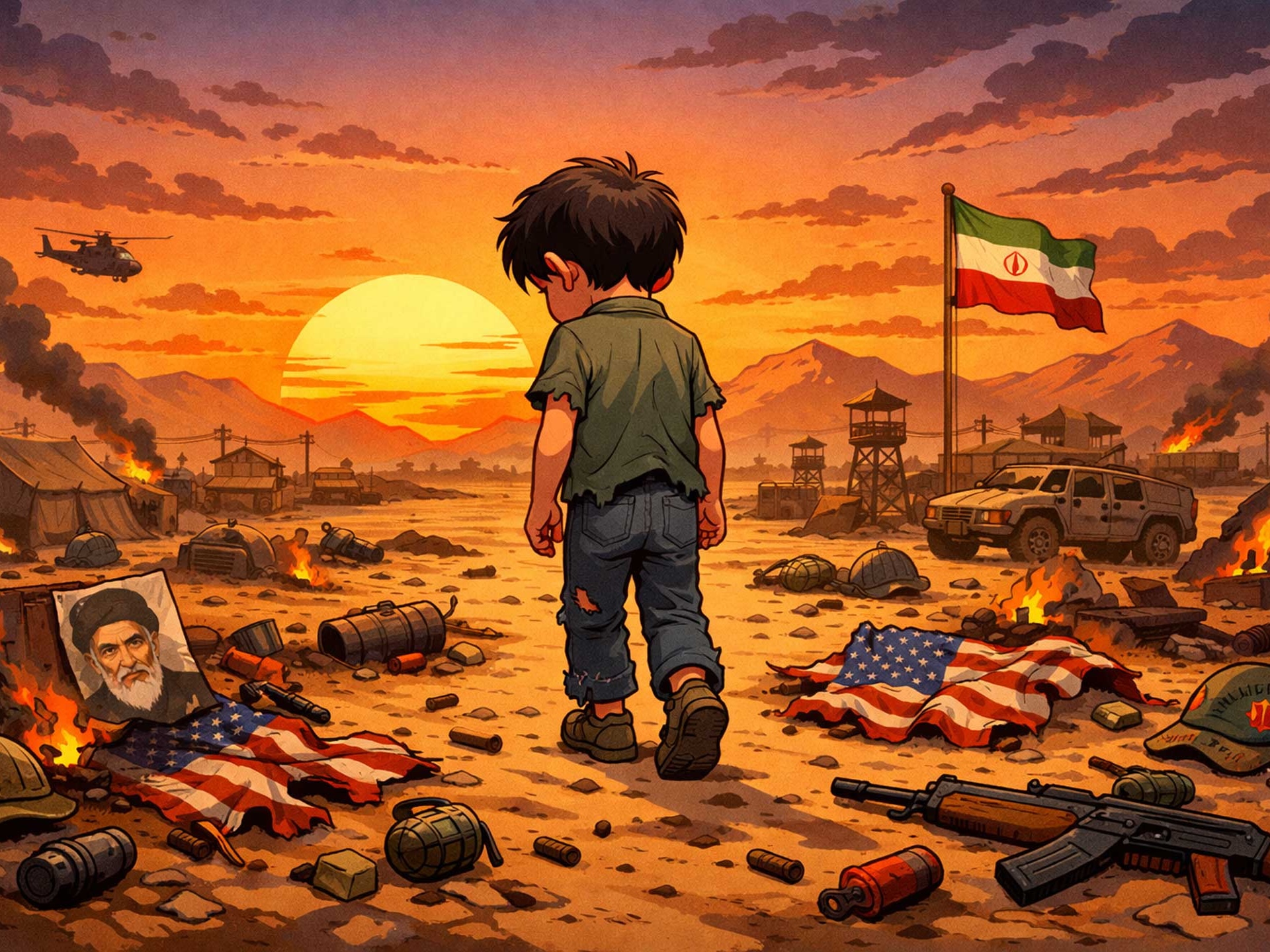
I remember what we now call Operation Desert Storm very well. I was almost nine at the time. The sound of the civil defence siren used to wake us up in the middle of the night as the coalition aircraft approached, and we rushed into the improvised bomb shelters made out of stacked sandbags. This happened many times. I remember the sound and sight of crying children being comforted by the adults. I felt so alone at the time, which made me unable to cry. Not so long after the war started, the MEK decided to transfer all the children, which amounted to around 3,000 at the time, to various Western countries in Europe and North America. Some were sent to family members living in those countries. But I believe most were sent to various offices or headquarters in those countries or were relocated to live with havadars (supporters of the MEK). The latter applied to me. I remember more and more of my friends disappearing every day and every week as they were sent to various parts of the world. I never saw them again, and it would be unlikely that I would even recall them. Then the day came that it was my turn to go. They gathered my group of kids and we were sent to a hotel in Baghdad where we awaited our transport out of the country. I think I only got to know of my destination at the very end.
One day a big bus came and they told us it was time to go. I said goodbye to my “latest mum,” whom I had grown to love. We started our journey, and after many hours we arrived at the border with Jordan. I remember the driver and the adults there having a lengthy discussion with the border guards when we suddenly started driving ahead at great speed. The adults screamed that we all had to get our heads down. As I lay on the floor I was awaiting the sound of spraying bullets tearing into our bus, but they never came, and we drove away.
Like many of the children who grew up around the MEK, my connection to the movement ended long ago, leaving only memories and unanswered questions.