Introduction
The uranium bomb dropped on Hiroshima on August 6, 1945, is frequently described as the “simple” atomic bomb. Nearly every history of the Manhattan Project explains that Little Boy used a gun-type design in which one subcritical mass of uranium-235 was fired into another to produce a supercritical assembly. Because this basic principle appears straightforward compared with the sophisticated implosion system of the Trinity device and the Fat Man bomb, many conclude that Little Boy itself was a relatively uncomplicated machine whose success was virtually guaranteed. That interpretation obscures the remarkable engineering embodied within the weapon.
Although the underlying nuclear physics of the gun method inspired considerable confidence among Los Alamos scientists, Little Boy was anything but simple. It represented the integration of precision machining, explosives engineering, electronics, radar technology, timing circuits, metallurgy, aerodynamics, electrical safety systems, and nuclear physics into a single weapon whose components had to perform flawlessly during less than one minute of free fall.
From the instant the bomb left the bomb bay of the Enola Gay until the nuclear chain reaction ended approximately forty-three seconds later, hundreds of individual mechanical and electrical events occurred in carefully controlled sequence. Understanding those final moments illustrates why Little Boy deserves recognition not merely as the first uranium bomb, but as one of the most sophisticated engineering systems constructed during the Second World War.
Leaving the Aircraft
At 8:15:17 a.m. Hiroshima time on August 6, 1945, Major Thomas W. Ferebee physically released Little Boy from the bomb bay of the Enola Gay at an altitude of approximately 31,000 feet (9,450 meters). The moment the weapon separated from the aircraft, electrical umbilical connections were automatically disengaged. These cables had supplied electrical power and maintained critical safety interlocks while the bomb remained aboard the aircraft. Their separation marked the transition from an aircraft-carried weapon to an autonomous nuclear system. Almost immediately, internal batteries assumed responsibility for powering the bomb’s electrical circuits.
Although often overlooked, Captain William S. Parsons, the mission’s weaponeer, had intentionally left the weapon partially unarmed during takeoff. Concerned about the possibility of a crash during departure from Tinian Island, Parsons and Second Lieutenant Morris Jeppson completed the final arming procedures only after the aircraft was safely en route to Japan. This unusual precaution underscores that even those who designed and delivered the bomb recognized the importance of multiple layers of safety.
The Forty-Three-Second Descent
During the first several seconds of free fall, Little Boy remained incapable of detonating. Internal timing mechanisms prevented activation of the firing circuitry until sufficient distance separated the bomb from the Enola Gay. Only after this delay elapsed did the weapon begin transitioning from a safe transport configuration into an armed nuclear weapon. As the bomb continued its descent, batteries energized the electrical systems; firing circuits became operational, and four independent radar proximity fuses entered service. Unlike conventional bombs that relied upon impact, Little Boy continuously measured its altitude by transmitting radio waves toward the ground and receiving their reflections. Multiple radar units provided redundancy in case of any individual system failures. Meanwhile, the bomb’s cruciform tail assembly stabilized its fall, minimizing rotation and maintaining the proper aerodynamic orientation required for reliable operation. Every one of these systems had to function correctly before the bomb could proceed to its final sequence.
The Final Milliseconds
Approximately forty-three seconds after release, Little Boy descended to about 1,900 feet (580 meters) above Hiroshima.
- Independent radar circuits confirmed that the programmed burst altitude had been reached. Only then did the firing system energize the conventional propellant located behind the uranium projectile.
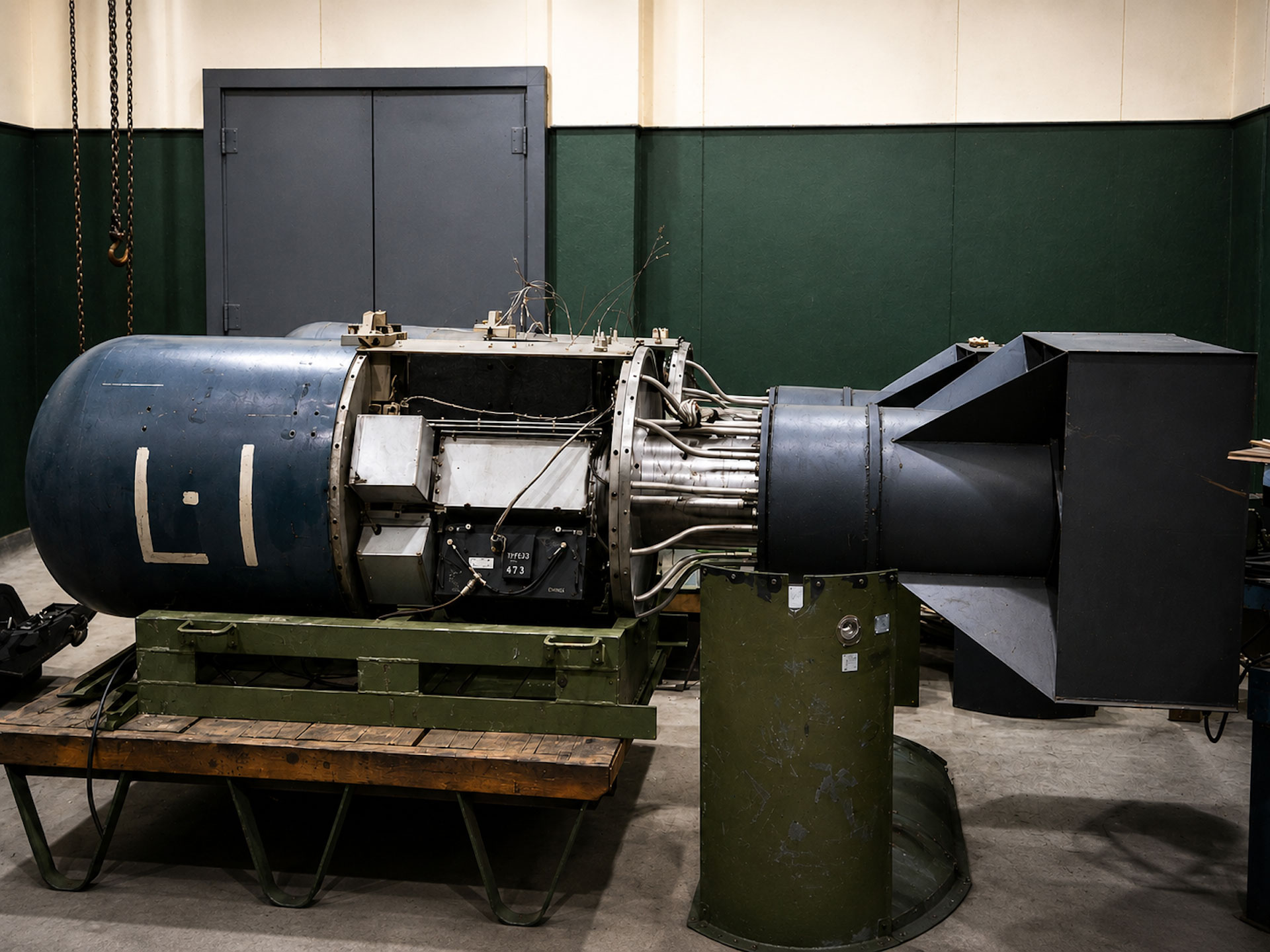
- The gun assembly inside Little Boy has often been compared to an artillery piece, but the comparison is misleading if it suggests ordinary engineering. The internal barrel, projectile, and target were manufactured to exceptionally demanding tolerances. Their dimensions, alignment, and timing were essential to achieving prompt criticality before the rapidly expanding energy of the chain reaction could disperse the fissile material.
- When the propellant ignited, expanding gases accelerated the uranium projectile down the barrel at several hundred meters per second.
- Within only a few milliseconds, the projectile struck the stationary uranium target.
- Two individually subcritical masses became one supercritical assembly.
A Millionth of a Second
At that instant, the bomb crossed the threshold from mechanical engineering to nuclear physics.
- Neutrons introduced into the newly assembled uranium core initiated the chain reaction. Each uranium-235 nucleus that underwent fission released additional neutrons capable of producing further fissions. The number of reactions doubled repeatedly in an exponential cascade unlike any previously experienced outside laboratory experiments.
- Within approximately one microsecond, temperatures climbed to tens of millions of degrees Celsius, comparable to those found within the core of the Sun.
- Pressures reached hundreds of billions of atmospheres.
- The bomb effectively destroyed itself from the inside outward.
- Contrary to popular belief, however, the chain reaction did not consume all of the uranium. As the rapidly expanding material dispersed below critical density, the nuclear reaction terminated naturally. Only a small fraction of the approximately 64 kilograms of uranium-235 actually underwent fission.
- Yet that comparatively tiny amount of matter, converted into energy according to Einstein’s equation E = mc², released approximately 15 kilotons of TNT equivalent.
The First Nuclear Fireball
Within fractions of a second, an intensely luminous fireball expanded outward from the point of detonation.
- Prompt gamma radiation and fast neutrons reached surrounding areas before the arrival of the blast wave. Thermal radiation ignited combustible materials across much of central Hiroshima, while the supersonic shock wave flattened buildings over an immense area.
- Within minutes, the familiar mushroom cloud climbed thousands of feet into the atmosphere.
What observers witnessed from the ground was the culmination of an engineering sequence that had begun less than one minute earlier when Little Boy separated from the Enola Gay.
More Than a “Simple” Bomb
The widespread characterization of Little Boy as a simple weapon reflects a misunderstanding of what scientists mean when they describe the gun method as “simple.”
The nuclear assembly principle was simpler than plutonium implosion because uranium-235 could be assembled relatively slowly without the danger of pre-detonation caused by spontaneous neutron emission. That did not mean the completed weapon was mechanically or electrically simple.
Its successful operation depended upon precision machining, reliable explosives, redundant radar systems, electrical interlocks, aerodynamic stability, carefully timed firing circuits, robust power supplies, meticulous in-flight arming procedures, and extraordinarily accurate calculations governing every stage of assembly.
Each of these systems represented advanced engineering in its own right.
Failure of a critical subsystem could have resulted in a dud or a substantially reduced nuclear yield.
The bomb succeeded not because it was crude, but because an unprecedented integration of scientific theory and engineering discipline functioned exactly as intended during forty-three seconds of free fall.
Conclusion
Eighty-one years after Hiroshima, Little Boy continues to be described as though it was merely a large gun firing one piece of uranium into another. While this shorthand explanation captures the fundamental principle, it conceals the extraordinary sophistication of the weapon itself.
The forty-three seconds between release and detonation were not passive moments of descent. They were a precisely choreographed sequence of electrical activation, mechanical safing, radar guidance, explosive propulsion, nuclear assembly, and exponential chain reaction, each dependent upon the flawless operation of the previous step.
Remembering those forty-three seconds reminds us that the first military use of atomic energy was not simply the triumph of theoretical physics. It was also one of the greatest engineering achievements, and one of the gravest technological turning points in modern history.